Do some parents really hope that their children will die?
Although Sigmund Freud wrote extensively about death wishes in the family, he devoted far more attention to the child’s desire to kill the parent and, also, any unwanted siblings, rather than upon the parent’s desire to murder the child. Donald Winnicott elaborated upon parental death wishes, especially in his classic essay “Hate in the Counter-Transference”, albeit rather briskly. Building upon these foundational psychoanalytical contributions, Brett Kahr will draw upon his work with psychotic and forensic patients and, also, with normal-neurotic individuals, to explore the many ways in which maternal and paternal death wishes and death threats towards babies and children become internalised over time and, ultimately, contribute to the development of severe psychopathology.
In this special event for the Wimbledon Guild, Professor Kahr will explore the concept of the “infanticidal attachment”, examining how early death threats can damage the very foundations of the ego structure, resulting in psychosis, suicidality, criminality, severe eating problems, life-threatening addictions, and a host of other extreme psychological states. Drawing upon extensive case material, he will consider how intensive, long-term psychoanalytically orientated treatment can contribute to the neutralisation of such toxic “infanticidal introjects”.
The speaker
Professor Brett Kahr has worked in the mental health profession for over forty years. He is Senior Fellow at the Tavistock Institute of Medical Psychology in London, and, also, Visiting Professor of Psychoanalysis and Mental Health in the Regent’s School of Psychotherapy and Psychology at Regent’s University London. He is, additionally, a Trustee of the Freud Museum London and of Freud Museum Publications, and, also, a Trustee of the United Kingdom Council for Psychotherapy, as well as Chair of the Scholars Committee of the British Psychoanalytic Council.
Author of fifteen books, including the best-selling Sex and the Psyche, as well as the popular books Tea with Winnicott and Coffee with Freud, he has also served as series editor for sixty further titles. His most recent books include: Bombs in the Consulting Room: Surviving Psychological Shrapnel; Celebrity Mad: Why Otherwise Intelligent People Worship Fame; and Dangerous Lunatics: Trauma, Criminality, and Forensic Psychotherapy.
He works full-time in independent practice and as a Consultant Psychotherapist to The Balint Consultancy.
Refund Policy
Regrettably, all online training workshop bookings are non-refundable in the event of cancellation in advance by you or your non-attendance on the day.
To contact Wimbledon Guild counselling training directly email: counsellingtraining@wimbledonguild.co.ukTerms of service – Counselling trainingThese terms of service apply to the provision of counselling training services by Wimbledon Guild (as described on our website at: https://www.wimbledonguild.co.uk/counselling-training, and within specific training event or service descriptions. Customers (also referred to as ‘you’) can book some events and services directly with us; others require booking via Eventbrite.In these terms, ‘Wimbledon Guild’ or ‘we’ or ‘us’ refers to Wimbledon Guild of Social Welfare, company number 00383330. Our address and contact details are set out in section 8 of these terms.Before making a booking (whether directly with us or via Eventbrite), please read these terms of service. By booking an event or other training service, you agree to these terms of service. We expect most of our customers booking our counselling training events and services will be doing so for purposes related to their business or profession. If you are booking for other purposes as a consumer, please let us know (using the contact details below) before making the booking, as there may be variations to the terms which apply.Note that Eventbrite may also have its own terms on which it provides its online event booking services, to which Eventbrite also requires your agreement. These are separate terms between you and Eventbrite.Please also see our privacy notice at: https://www.wimbledonguild.co.uk/privacy-policy. 1. Making a bookingWhere you make a booking directly with us or via Eventbrite, you are entering into a contract with us for the provision of the relevant training event or services. Either we or Eventbrite will provide you with confirmation of your booking.2. Fees and paymentYou will be informed prior to booking an event or other service of the specific fees which you must pay for them. Payment must be made in full in advance of the event or service, and, subject to the cancellation and refund provisions at sections 3 and 4 below, the fees are non-refundable.Where you book the services via Eventbrite, payments may be made as directed on the Eventbrite site. Where you book the services directly with Wimbledon Guild, we will let you know available payment methods. We may change our fees for our services at any time, so fees previously quoted may have changed at the time you make your booking. Promotional discounts offered by Wimbledon Guild Counselling Training after you have made your booking cannot be claimed or applied retrospectively to that booking. Please see section 7 below in relation to the discount for trainee counsellors.Note that event fees have increased 2.5% from April 2020 with the exception of trainee counsellor event fees which have remained at the same rate. 3. Cancellation by you The following cancellation and refund provisions apply to bookings, except:• for events and training delivered online, which are non-refundable; or• to the extent otherwise stated in the description of the relevant event or service. You may cancel a booking by email (to the email address at section 8 below):• at least 60 days before the first date of the event or service you have booked, in which case you will be entitled to a 100% refund; or• between 30 and 60 days before the first date of the event or service you have booked, in which case you will be entitled to a 50% refund.As an alternative to these refunds, you have the option for us to issue you with a credit note to be used for a future event.These cancellation and refund (or credit) provisions do not apply to parts of an event such as a seminar within a series, but only to a whole event or complete series.If you cancel under 30 days before the first date of the event or service, then you will not be entitled to any refund or credit. However, you may give your place at an event to another person if you let us know that person’s name at least 24 hours before the event begins. If you are unable to attend an event due to a tube or rail strike, you will be entitled to a refund of half the event fee provided you email or telephone us (using the contact details at section 8 below) within two days of the event. At times the weather conditions (such as snow) may impact transport to an event; in this circumstance if you cannot attend, you will not be entitled to a refund. 4. Changes or cancellation by usWe may change a speaker at one of our events, or make minor changes to the content of the event or service, without offering a refund. However, if a solo presenter cancels then we will offer you a full refund or transfer your fee to another Wimbledon Guild Counselling Training event.We may need to cancel an event or service (and will provide you with a refund):• should our minimum numbers not be reached by the closing time for bookings; or• in other circumstances beyond our reasonable control.5. Online delivery of servicesWhere an event or service is to be provided online, you (or anyone attending the event or service in your place) will need to make your own arrangements to access the internet and the appropriate online communications facility. If you have any problems with this, please let us know, and we will discuss the options with you.6. Your behaviourYou must behave responsibly and appropriately during the provision of our services, and be respectful of others attending an event (and you must ensure that anyone attending in your place does the same). You may be asked to leave an event if your behaviour is not appropriate.7. Discounts for trainee counsellors – conditions of booking your discounted ticket this applies to face to face workshops only and not online CPDWhen booking a discounted trainee rate, you will need to bring to your event one of the following:• your student ID card;• your BACP student membership card; or• an email from your institution to confirm enrolment on your course.If you do not provide such a document at (or prior to) the event, this could prevent you obtaining future trainee discount tickets with Wimbledon Guild Counselling Training.8. Wimbledon Guild address and Counselling Training contact detailsWimbledon Guild of Social WelfareAddress: Guild House, 30-32 Worple Road, Wimbledon, SW19 4EFEmail: counsellingtraining@wimbledonguild.co.ukTelephone: 020 8296 0030
The esteemed B.B.C. broadcaster has recently interviewed Brett Kahr about his book on Freud’s Pandemics: Surviving Global War, Spanish Flu, and the Nazis, as well as such topics as the nature of self-destructive behaviour and other-destructive behaviour during the coronavirus pandemic.
Here are the links to the podcast, available both on Chrissie Pollard’s website and, also, on YouTube.
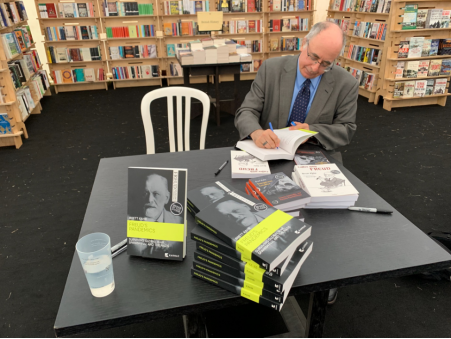
In June, 2022, Professor Brett Kahr spoke at the Chalke Valley History Festival in Broadchalke, near Salisbury, in Wiltshire, about “Are We All Mad?: The History of the Human Mind, its Brilliance, and its Frailties”. He had the privilege to participate in an “in conversation” with the distinguished novelist, Sebastian Faulks, author of a gripping novel on nineteenth-century psychiatry called Human Traces.
After the conversation about the past, present, and future of “madness” with Mr. Faulks, Kahr enjoyed meeting many of the guests at a Waterstone’s book-signing.
To mark the publication of Professor Brett Kahr’s newest book, Freud’s Pandemics: Surviving Global War, Spanish Flu, and the Nazis, the Swiss psychiatrist Dr. med. Sebastian Thrul has conducted a full interview with Kahr, which offers insights into how Sigmund Freud handled the multiple pandemics of his own lifetime and how he would have advised our governments and our health care specialists had he been alive today during the twenty-first century.
This podcast is Kahr’s third appearance on “New Books in Psychoanalysis”. The New Books Network had previously interviewed him about two of his other publications, namely, How to Flourish as a Psychotherapist and, also, Bombs in the Consulting Room: Surviving Psychological Shrapnel.
The New Books Network has recognised that Kahr’s latest title will be of interest not only to members of the psychoanalysis community but, also, to those from other disciplines; consequently, the podcast has been posted not only on “New Books in Psychoanalysis” but, also, on “New Books in Biography”, “New Books in German Studies”, “New Books in History”, “New Books in Intellectual History”, and “New Books in Jewish Studies”.
Kahr’s book is the inaugural title in the new “Freud Museum London Series”, published by Karnac Books of London (an imprint of Confer Limited), in association with Freud Museum London.
To listen to the podcast, please click on either of the following links:
We talk to Professor Kahr about his new book and his keynote presentation at Wimbledon Guild Counselling Training’s 2022 Conference: Reflections on the Pandemic, Covid-19 and Trauma
Professor Brett Kahr has worked in the mental health profession for more than 40 years. He is Senior Fellow at the Tavistock Institute of Medical Psychology in London and Visiting Professor of Psychoanalysis and Mental Health at Regent’s University London.
After serving for many years as Trustee of Freud Museum London and of Freud Museum Publications, he has now become the museum’s Honorary Director of Research.
We caught up with Professor Kahr to talk about his new book Freud’s Pandemics: Surviving Global War, Spanish Flu, and the Nazis (Karnac Books, 2021), inspired by the Covid-19 pandemic and to discuss his keynote presentation at our online 2022 Conference: Reflections on the Pandemic, Covid-19 and Trauma, Saturday 12th March 2022.
We are delighted that you will be presenting your new paper, “Unmuzzling Experts While Curing ‘Covidiots’: How Psychotherapists Can Prevent the Next Pandemic”, at our online conference next year. Could you tell us something more about the concept of “unmuzzling health professionals”?
Throughout this heart-wrenching coronavirus pandemic, we have received an overwhelming amount of data from politicians and public health officials about how to manage this dreadful global health crisis. However, in spite of the fact that broadcasters have reported a great deal about the decline in mental health, and in spite of the fact that members of the psychotherapeutic profession have never worked so hard, our insights about the unconscious roots of self-destructiveness and other-destructiveness have not become at all central to the narrative surrounding Covid-19. We know that many people contracted the virus quite unexpectedly, but many others have continued to spread this awful infection as clinical acts of aggression.
I believe that the psychotherapeutic and counselling professions have a great deal of insight to contribute towards a better understanding of the hidden unconscious and behavioural factors underlying what we might conceptualise as “unconscious viral transmission”.
During the pandemic, you have been delivering online lectures for Wimbledon Guild, Confer, The Freud Museum London, and the Viktor Wynd Museum, to name just a few organisations. What has it been like for you delivering your work online over Zoom?
I presented my very first public lecture back in 1979, in front of a live audience, so I must confess that switching to Zoom in 2020, more than 40 years later, proved rather a challenge at first, never having used a laptop before!
Fortunately, the wonderful technologically savvy team at Freud Museum London offered me a veritable masterclass in Zoom and I presented a fund-raising talk to help the museum, entitled “How Freud Would Have Handled the Coronavirus: Lessons from a Beacon of Survival”, which became the basis of my most recent book.
Naively, I presumed that the attendees would consist predominantly of the London “regulars”, but, to my great surprise and delight, we attracted colleagues from India, Iran, Pakistan and all over the world. And no one had to hop on an aeroplane! I have now become quite used to this new form of communication and it has permitted us all to meet some very intelligent individuals overseas with whom we would have had little or no contact in pre-pandemic times.
Please tell us about your new book, Freud’s Pandemics: Surviving Global War, Spanish Flu, and the Nazis, which has just been published.
Over the last year, we have heard a great deal about everyone’s “lockdown projects”. Some people have finally learned how to speak Italian fluently or have dusted off their old violin. I devoted much of my time to the writing of a new book on Freud’s Pandemics: Surviving Global War, Spanish Flu, and the Nazis, to help inaugurate the new “Freud Museum London Series” in association with the re-launched Karnac Books.
It will not be widely known that during his long lifetime Sigmund Freud endured not one pandemic but, rather six, of many varieties, including the so-called “Spanish Flu”, which claimed the life of his beloved daughter Sophie Freud Halberstadt in 1920.
Freud also had to endure decades of anti-Semitic abuse and professional shaming, as well as 16 years of cancer treatment, not to mention the invasion by the Nazis. Any other person who experienced such trauma might have passed by their own hand, but Freud always maintained great emotional sturdiness.
In this book, based on oral historical and archival research, as well as on a close reading of Freud’s untranslated letters, I have crafted a narrative of his six pandemics. I have also explored how he might have dealt with Covid-19 and, also, what lessons we may continue to learn from this iconic genius.
What are you most looking forward to about Wimbledon Guild Counselling Training’s 2022 online conference?
I believe that the 2022 conference will be my sixth lecture for Wimbledon Guild over the last 20 years. I have always had a wonderful time speaking to colleagues at this esteemed organisation. No two institutions attract the same type of audience, but those at Wimbledon Guild always respond with tremendous compassion and wisdom, and I hope that we can all learn a great deal from one another. The Covid-19 pandemic has devastated much of world thought due to massive traumatisation; therefore, no one can claim true expertise about the psychological impact of this awful illness or about the best ways in which to promote psychological prevention, but I do hope and trust that we can all pool our well-analysed minds at this conference and begin to craft a plan about how psychotherapists and counsellors can share our skills and insights even more fully in years to come.
Wimbledon Guild Counselling Training’s 2022 online conference: Reflections on the Pandemic, Covid-19 and Trauma is on Saturday 12th March 2022. View the programme and book tickets.
Susie Orbach review of How to Do Things With Emotions: The Morality of Anger and Shame Across Cultures by Owen Flanagan – Don’t shout, let it all out The Observer, 9/1/22
In this compelling book, the first in the new “Freud Museum London Series”, Professor Brett Kahr describes how Sigmund Freud endured innumerable emotional pandemics during his eighty-three years of life, ranging from unsubstantiated accusations by medical colleagues to anti-Semitic abuse, the loss of one daughter to Spanish flu and the arrest of another child by the Gestapo, to his own painful cancer treatments and his final flight from Adolf Hitler’s Austria. Freud navigated these personal and political tragedies while simultaneously creating a method of healing which has helped countless millions deal with unbearable trauma and distress.
Kahr argues that, by having created psychoanalysis, Freud not only saved himself from destruction but also provided the rest of the world with the means to achieve a form of psychological vaccination against emotional and mental distress.
The Freud Museum London and Karnac Books have joined forces to publish a new book series devoted to an examination of the life and work of Sigmund Freud alongside other significant figures in the history of psychoanalysis, psychotherapy, and depth psychology more broadly. The series will feature works of outstanding scholarship and readability, including biographical studies, institutional histories, and archival investigations. New editions of historical classics as well as translations of little-known works from the early history of psychoanalysis will also be considered for inclusion.
REVIEWS AND ENDORSEMENTS.
“A vivid account of how Sigmund Freud coped with the great ‘pandemics’ of his time, from the Great War and Spanish Flu to cancer and the Nazis. By assessing how my great-grandfather might have addressed COVID-19 – the pandemic of our own times – Professor Kahr opens up a series of insights into the life of the man who championed the radical innovation of actually listening to people suffering from mental affliction. Meticulously researched, and written with real pace, this book is a timely reminder of the psychological roots of our response to national trauma.” – Lord Freud, great-grandson of Sigmund Freud and President of the Freud Museum London
“Never has there been a time when Freud was needed so badly. Post-pandemic blues would not have been new to Freud as Brett Kahr describes in his phenomenal book, which I feel was sent to save us from confusion and turmoil. A must read!” – Jane McAdam Freud, artist, and great-granddaughter of Sigmund Freud.
“Brett Kahr’s immersion in Freud – the gift that keeps on giving – will help us survive the trauma of pandemics in our own lives. Kahr draws insightful parallels from Freud’s own struggles and serves as a timely and fascinating reminder of the ubiquitous nature of pandemics and why suicide isn’t the answer.” – Professor the Baroness Hollins, Past President of the British Medical Association, Past President of the Royal College of Psychiatrists and Professor Emerita at St. George’s Hospital Medical School, University of London.
CONTENTS OF THE BOOK.
Prologue: Fundraising for Freud
Introduction: “Wouldn’t it be better if we all killed ourselves?”
Chapter 1: The Fraudulent Jewish Pervert: Navigating Decades of Collegial Hatred
Chapter 2: The Great War and the Spanish Flu: An Imprisoned Son and a Dying Daughter
Chapter 3: From Compulsive Cigar-Smoking to Deadly Carcinoma: Freud’s Battle with Physical Pain
Chapter 4: Death Wishes and the Nazis: How Freud Escaped from Austria
Chapter 5: Freud’s Recipe for Creativity and Survival: The Writing Cure and the Role of Penetrativity
Conclusion: If Sigmund Freud Could Have Supervised Anthony Fauci